INSTITUTE FOR THE DEVELOPMENT OF THE NATIONAL QUALIFICATION SYSTEM
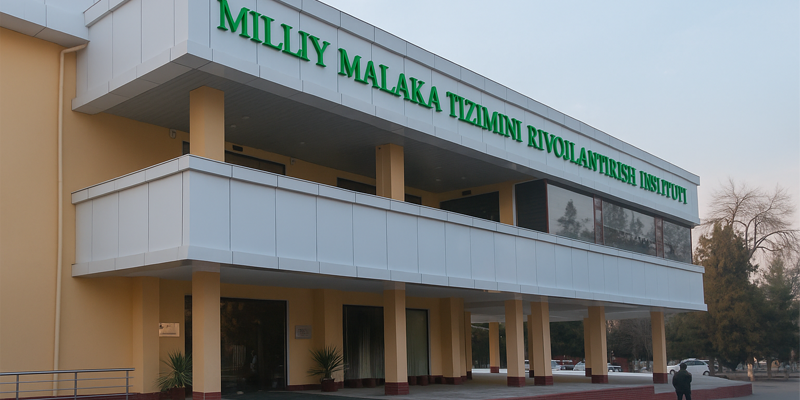
The Institute for the Development of the National Qualification System in Uzbekistan was established in accordance with the Resolution of the President of the Republic of Uzbekistan No. PQ-345 dated of September 30, 2024, titled “On Measures for the Further Improvement of the National Qualifications System of the Republic of Uzbekistan.”
Furthermore, under the Resolution of the Cabinet of Ministers No. VMQ-369 dated of June 17, 2025, “On the Approval of Certain Regulatory Legal Documents Aimed at Regulating the National Qualifications System of the Republic of Uzbekistan,” the Institute for the Development of the National Qualifications System under the National Quality Assurance Agency for Education, operating under the Administration of the President of the Republic of Uzbekistan, serves as the working body of the Republican Council and functions as the coordinating regulator of the National Qualifications System.
Main Areas of Activity and Functions:
- Acting as the working body of the Republican Council for the Development of Professional Qualifications;
- Providing organizational and methodological support for the activities of the Republican Council, sectoral councils, and qualification assessment centers;
- Exercising general oversight over the development of sectoral qualification frameworks, professional standards, and assessment tools, coordinating activities related to their expert review and implementation;
- Issuing conclusions on the compliance of educational programs with relevant professional standards or qualification requirements;
- Accrediting qualification assessment centers, monitoring their activities, maintaining their registry, and providing methodological assistance when necessary;
- Introducing a unified digital platform for the National Qualifications System, providing its technical support, integrating it with other information systems, as well as collecting, analyzing, and processing data related to the National Qualifications System;
- Developing proposals and recommendations for the development and improvement of the National Qualifications System, as well as providing methodological services in this field;
- Improving the qualifications of members of sectoral councils and employees of qualification assessment centers;
- Forming and maintaining the national registry of certified individuals and the registry of professional standards;
- Coordinating the activities of specialists in ministries and agencies responsible for the development of professional qualifications and providing them with practical assistance;
- Developing draft regulatory legal acts in the field of National Qualifications System development;
- Participating in the implementation of prospective projects in the field of National Qualifications System development;
- Performing the functions of a coordinating regulator for the National Qualifications System.
Strategic Goals:
- Improving the regulatory, institutional, and methodological foundations of the National Qualifications System;
- Gradually aligning the national classifier of occupations, jobs, and positions with international standards;
- Developing, implementing, and enhancing qualification frameworks, professional standards, and qualification requirements based on employers’ needs;
- Regulating labor relations on the basis of next-generation professional standards, improving higher and vocational education programs, and bringing the personnel training system to a qualitatively new level;
- Ensuring the international recognition of qualifications and integrating national qualification levels with those of advanced foreign countries;
- Introducing a system for recognizing non-formal and informal acquired skills and qualifications (“Recognition of Prior Learning”);
- Developing and implementing tools and methodologies for forecasting skills, analyzing skills demand, and studying issues related to skills development;
- Designing strategic plans for the full-scale implementation of the National Qualifications System and expanding the participation of the private sector;
- Monitoring the processes of developing the National Qualifications System, studying public opinion, and establishing effective information exchange.
Foundational Principles of Activity:
- Innovation – applying new approaches and utilizing modern technologies.
- Transparency – ensuring openness and fairness in all processes.
- International Cooperation – integrating global best practices into national implementation.
- Capacity Building – fostering professional growth and development.
- Teamwork – achieving results through collaborative efforts.